Presentation
DOI:
https://doi.org/10.22201/fesa.26832917e.2025.6.1.396Keywords:
Figuras, Perspectives,, Scenarios, Resonances, UNAM, RousseauAbstract
The relevance of the notion of human liberty is the central theme, though not the only one, of the research articles that compose the dossier of FIGURAS REVISTA ACADÉMICA DE INVESTIGACIÓN on Jean-Jacques Rousseau´s thought.
With four texts, the aim is to provide an approach -always partial, but with analytical sharpness and in-depth arguments- to the current relevance and understanding of the thought of the writer from Geneva.
The complex dyad “liberty and authority” is presented and reflected upon with a consistent discourse where the authors may dissent in their approaches, but maintain a coherent response to the questions raised by the notions of liberty, democracy and human dignity.
Thus, the relevance of the topics are present in each article as the following: “Jean-Jacques Rousseau’s Subtractive Democracy” explains how individuals agree in order to form a collective that they believe it will be beneficial to them; “The extraordinary lawmaker in The Social Contract. A Schmittian reading” aims to demonstrate that the “extraordinary lawmaker” has the function as a postulate not explicitly recognized by Rousseau and to unravel its argumentative performance; in “On compacts, authority and liberty in Rousseau: Wolmar, Jean-Jacques and the extraordinary Legislator” is explored the relation between liberty and authority in the light of three episodes taken from The New Heloise, Emile and The Social Contract; finally, in “Human formation in Rousseau: Emilio and the figure of the paladin” is aimed to explore the pedagogical novel by the philosopher from Genova from the perspective of the bildungsroman where he mentions Don Quijote de la Manche to draw a comparison between the figure of the paladin and Emilio, the main character of his treatise.
In the Articles (Perspectives) section, three research articles develop the multidisciplinary dialogue. “On war in Ukraine. A critical approach to Jürgen Habermas” analyzes, from a critical perspective, two essays and some written proposals by the German philosopher and sociologist on the Russia-Ukraine war. The second article, “Digital Open Municipal Government Index in Estado de México” develops an index for assessing this type of government, specifically at the municipal level; regarding the third text, “Digital Humanities and resources for History. Theories and formative practices” raises the need to reflect on the impact of digital technology on research and teaching in the Humanities, particularly in History. Furthermore, a review article was published: “Prevention and Business Leadership: Key to Continuity in the Absence of Executive Directors”, where the prevention of the possible absence of those who lead a company and the solutions to a catastrophic scenario are addressed.
Finally, the Critiques (Resonances) section includes four critical reviews: “The confession of Jean-Jacques Rousseau through Mauro Armiño´s perspective” extends a broad perspective of the edition of Las confesiones; “Is it possible to educate the reader?”, originally written in Portuguese, argues around the work of John T. Scott titled Rousseau’s reader: Strategies of Persuasion and Education; “Pedagogy and literature. Teaching Thinking” it deals with a book that is the result of courses, seminars and conferences that Humberto Quiceno taught over 20 years; lastly, “Critical Cartography of AI” proposes some imaginaries of artificial intelligence based on different references related to the media narratives.
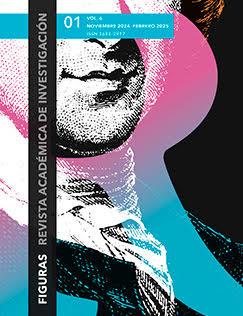
FIGURAS REVISTA ACADÉMICA DE INVESTIGACIÓN provides free and immediate access to its content so its readers freely dispose of research articles, essays and reviews, with the purpose of be joined in the impetus that the Universidad Nacional Autónoma de México is providing to the content exchange of the investigations that are being carried out in the country, through the Open Access (OA) model, known as a way to share scientific and academic information without any cost or restriction for the user, and in every article, essay, or review this appears in a unique way.Downloads
References
FIGURAS REVISTA ACADÉMICA DE INVESTIGACIÓN 6 (1): 8-30. https://doi.org/10.22201/fesa.26832917e.2025.6.1.396 DOI: https://doi.org/10.22201/fesa.26832917e.2025.6.1.396
Downloads
-
Abstract 619
-
PDF (Spanish) 181
Published
Issue
Section
License
Copyright (c) 2024 Coordinación editorial

This work is licensed under a Creative Commons Attribution-NonCommercial-ShareAlike 4.0 International License.
All works published in FIGURAS REVISTA ACADÉMICA DE INVESTIGACIÓN are subject to an Attribution-NonCommercial-ShareAlike 4.0 International license. Authors are owners of their articles and can republish them in other media, provided that they communicate it to the editors and indicate the texts were originally published in FIGURAS REVISTA ACADÉMICA DE INVESTIGACIÓN
How to Cite
Metrics